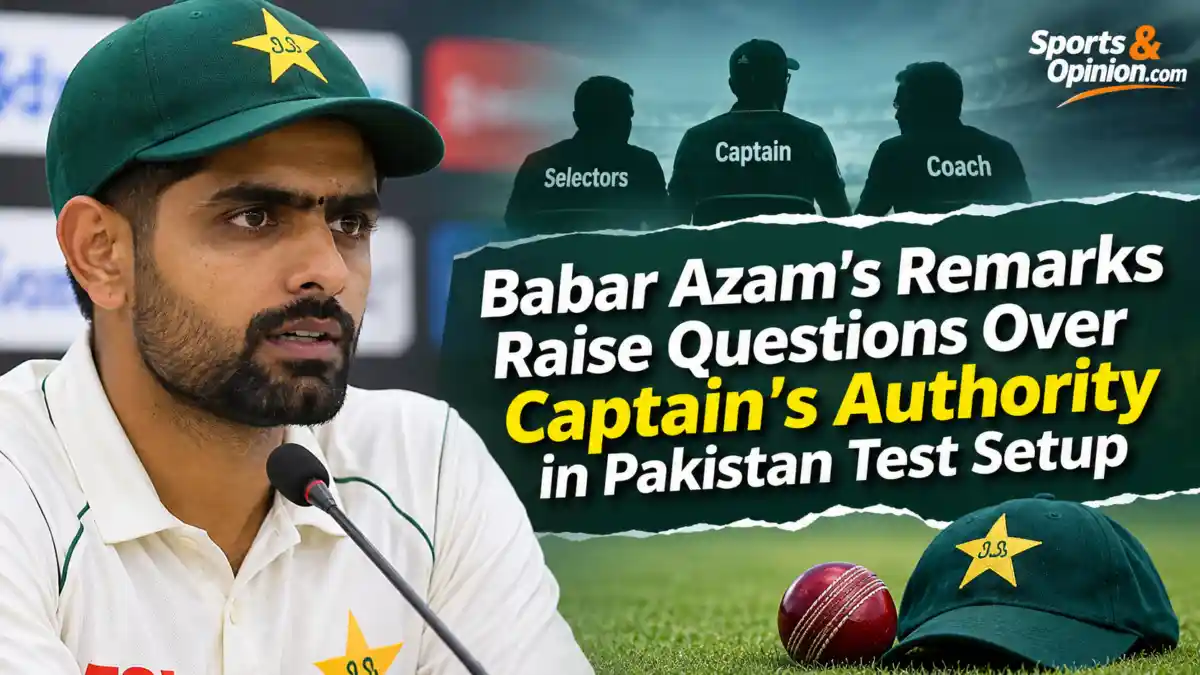
Pakistan Test captain Babar Azam’s remarks about his limited role in team selection have sparked an important debate over the authority of the captain and the division of responsibilities between the team management, selectors and coaching staff.
Speaking at the pre-series press conference ahead of the first Test against Sri Lanka, Babar revealed that the selectors and coach had selected the 15-member squad, while his responsibility was to choose the playing XI from the available players, get the best out of them and make the team competitive.
He made it clear that the selection and exclusion of players were not entirely in his hands, although he provided input whenever required and discussed possible combinations with the selectors and coach.
His comments have raised a fundamental question about the position of a Test captain: how can a leader be held fully responsible for the team’s performance if his influence over the composition of the squad is limited?
The issue goes beyond the selection of individual players. It concerns the authority, accountability and leadership structure within Pakistan cricket.
In Test cricket, the captain is expected to be the central figure in managing the team. He understands the players’ abilities, their temperament under pressure, their strengths and weaknesses, and the roles they can perform in different match situations.
A captain also needs the confidence of his players. They must believe that their leader supports them and that their performances, commitment and contributions are recognised within the dressing room.
When decision-making authority is divided between the captain and other influential figures in the management, it can create uncertainty over leadership and accountability. Players may find themselves looking towards different centres of authority rather than treating the captain as their principal leader.
This does not mean selectors and coaches should have no say in team matters. Their expertise is essential in identifying talent, assessing performances, planning combinations and improving players. However, their primary responsibility should be to strengthen the team and support the captain rather than undermine his leadership.
The coaching staff should focus on making players technically sound, mentally prepared and emotionally confident. They should help young cricketers understand the importance of Test cricket and the opportunity to build lasting careers in the longest format.
The captain, meanwhile, should have a meaningful voice in deciding the team’s direction and the players who will represent the country.
Babar’s comments also bring into focus the need for a transparent selection and accountability system. If selectors are responsible for selecting the squad, the captain for choosing the playing XI and the coaching staff for preparing the players, their respective responsibilities must be clearly defined.
Pakistan’s recent disappointing performances in England have already prompted major changes in the Test setup. The introduction of young players against Sri Lanka is part of an effort to rebuild the side and prepare for the next World Test Championship cycle.
The encouraging performances of debutants Tayyab Arif and Mohammad Taha on the opening day have demonstrated the potential of the new generation. However, introducing young talent must be accompanied by patience, continuity and confidence in the players.
Pakistan need to ensure that promising cricketers are not discarded after one or two disappointing performances. The captain and coaching staff must work together to develop their skills and give them sufficient opportunities to establish themselves.
Ultimately, the success of Pakistan’s Test revival will depend not only on identifying talented players but also on creating a strong leadership structure in which authority and accountability go hand in hand.
A captain cannot be expected to take responsibility for every result without having an appropriate say in the decisions that shape his team. Pakistan cricket must therefore establish a system in which the captain is empowered to lead, the selectors are accountable for their choices and the coaching staff provides the support needed to build a competitive Test side.